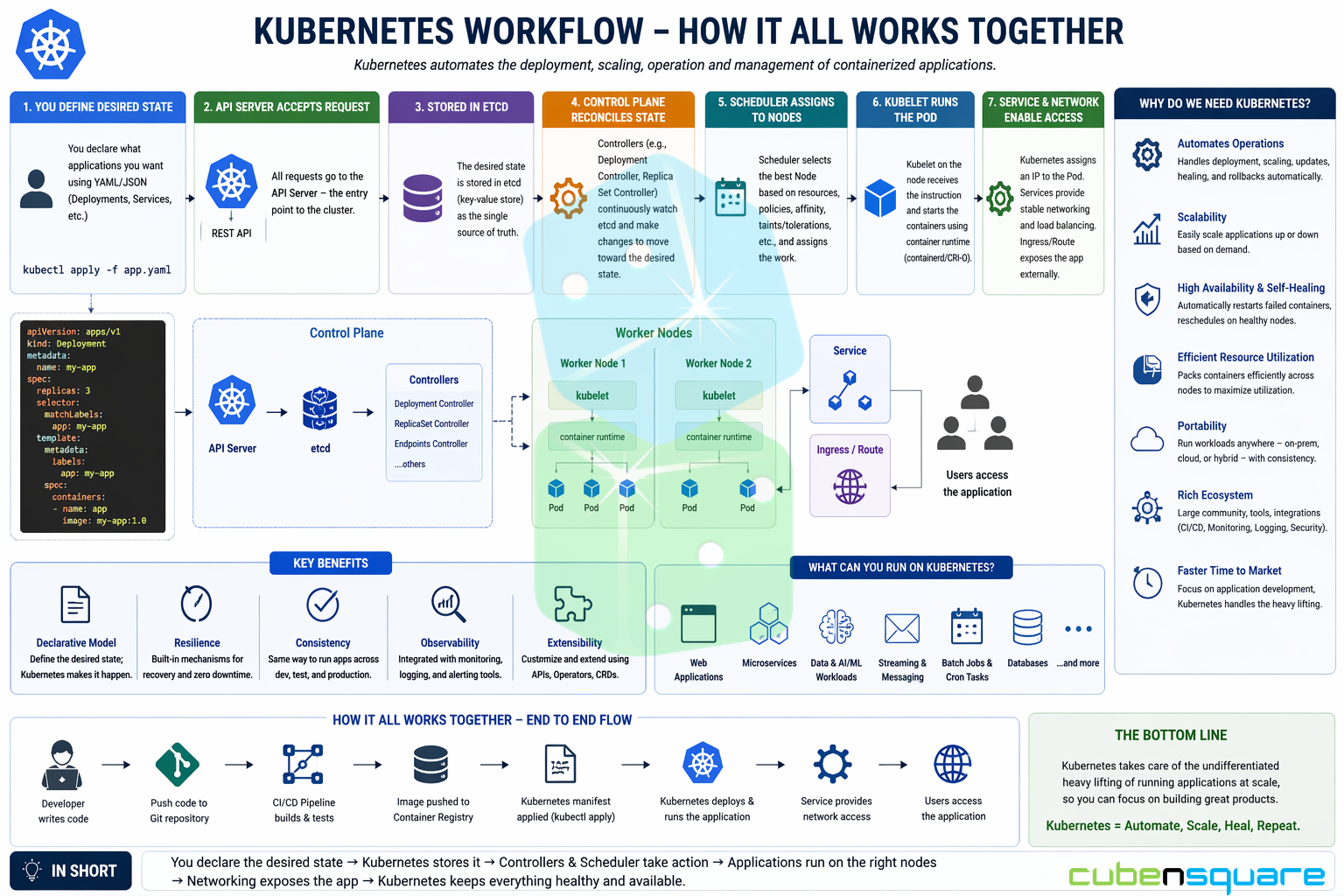
Kubernetes simplifies how modern applications are deployed and managed by automating the entire lifecycle—from deployment to scaling and healing. It starts when you define the desired state of your application using YAML files (Deployments, Services).
This request is sent to the API Server, which acts as the entry point to the cluster and stores the configuration in etcd, the system’s source of truth. The control plane (controllers + scheduler) continuously ensures that the actual state matches the desired state. Controllers monitor changes and take corrective actions, while the scheduler assigns workloads (Pods) to the most suitable worker nodes.
On each worker node, the kubelet pulls container images and runs them using a container runtime. Once running, Services and Ingress expose the application, enabling secure and stable access for users. In essence, Kubernetes follows a simple loop: Declare → Schedule → Run → Expose → Heal This automation provides key benefits like self-healing, scalability, load balancing, and efficient resource utilization, allowing teams to focus on building applications rather than managing infrastructure.