Redhat OpenShift 380
DO380 | EX380
- 10 Chapters
- Redhat Ebook
- Redhat Exam
Red Hat OpenShift Administration III: Scaling Deployments in the Enterprise
Plan, implement, and manage OpenShift clusters at scale
Red Hat OpenShift Administration III: Scaling Kubernetes Deployments in the Enterprise (DO380) expands upon the skills required to plan, implement, and manage OpenShift® clusters in the enterprise. You will learn how to configure and manage OpenShift clusters at scale to address increasing and special demands from applications and ensure reliability, performance, and availability.
This course builds upon the essential skills required to configure and manage an OpenShift 4.x cluster, teaching the enhanced skills needed to operate production environments at scale.
Authentication and Identity Management
- Configure OpenShift clusters to authenticate by using LDAP and OIDC enterprise identity systems and to recognize groups that those systems define.
Backup, Restore, and Migration of Applications with OADP
- Backup and restore application settings and data with OpenShift APIs for Data Protection (OADP).
Cluster Partitioning
- Configure a subset of cluster nodes to be dedicated to a type of workload.
Pod Scheduling
- Configure workloads to run on a dedicated set of cluster nodes and prevent other workloads from using those cluster nodes.
OpenShift GitOps
- Deploy OpenShift GitOps for managing clusters and applications.
OpenShift Monitoring
- Troubleshoot performance and availability issues with applications and clusters.
OpenShift Logging
- Deploy OpenShift logging and query log entries from workloads and cluster nodes.
This course is an advanced course so prerequsite knowledge is required
- Complete Red Hat OpenShift Administration II: Operating a Production Kubernetes Cluster(DO280) and become a Red Hat Certified Specialist in OpenShift Administration or equivalent practice knowledge
- Complete Red Hat System Administration II (RH134) and become a Red Hat Certified System Administrator or equivalent practice knowledge.
Recommended, but not required:
- Become a Red Hat Certified Systems Engineer or a Red Hat Certified Specialist in Ansible Automation.
- Basic knowledge about writing and running Ansible playbooks is desired.
Take Red Hat free assessment to gauge whether this offering is the best fit for your skills Red Hat Skills Assessment
Exam Objectives
- Configure and manage OpenShift Authentication and Identities
- Integrate OpenShift with LDAP
- Integrate OpenShift with the Red Hat SSO OIDC (Keycloak)
- Manage multiple identity providers
- Configure authentication
- Configure and synchronize OpenShift groups
- Resolve synchronization conflicts
- Maintain group synchronization on a scheduled basis
- Configure RBAC roles with users and groups
- Create and use authentication tokens with kubeconfig files
- Create and use authentication certificates with kubeconfig files
- Back up and restore applications with OpenShift API for Data Protection (OADP)
- Export and import a Kubernetes application
- Export and import container images
- Deploy the OADP operator
- Configure a full application backup including data and resources
- Configure and use volume snapshots
- Schedule a recurring backup
- Restore applications
- Manage workloads with cluster partitioning
- Dedicate multiple cluster nodes to a specific workload
- Configure and work with node pools
- Configure and work with machine configurations
- Use the machine configuration operator and special purpose operators
- Manage workloads with pod scheduling
- Configure workloads to run on dedicated cluster nodes
- Prevent workloads from running on dedicated cluster nodes
- Configure and work with node taints and tolerations
- Configure and work with node labels and selectors
- Configure and work with project tolerations
- Configure application resiliency using pod disruption budgets
- Configure and use affinity rules
- Implement OpenShift GitOps
- Deploy OpenShift GitOps operator
- Configure users, instances, and integrations
- Configure Argo CD
- Create pipelines and repositories
- Integrate with Git, Helm, Kustomize, etc
- Configure GitOps for cluster administration
- Configure GitOps for application management
- Manage cluster monitoring and metrics
- Troubleshoot performance and availability issues with applications and clusters
- Configure and silence alerts and notification
- Provision and inspect cluster logging
- Configure OpenShift logging to forward logs to an external aggregator
- Configure OpenShift logging for short-term log retention and aggregation
- Deploy OpenShift logging with Vector and Loki
- Deploy the Event Router to log Kubernetes events
- Query logs from cluster services and node services
- Diagnose cluster logging problems
Other Redhat Courses
Master Red Hat Linux, Ansible Automation, OpenShift, OpenShift AI, Virtualization, and Enterprise Kubernetes.
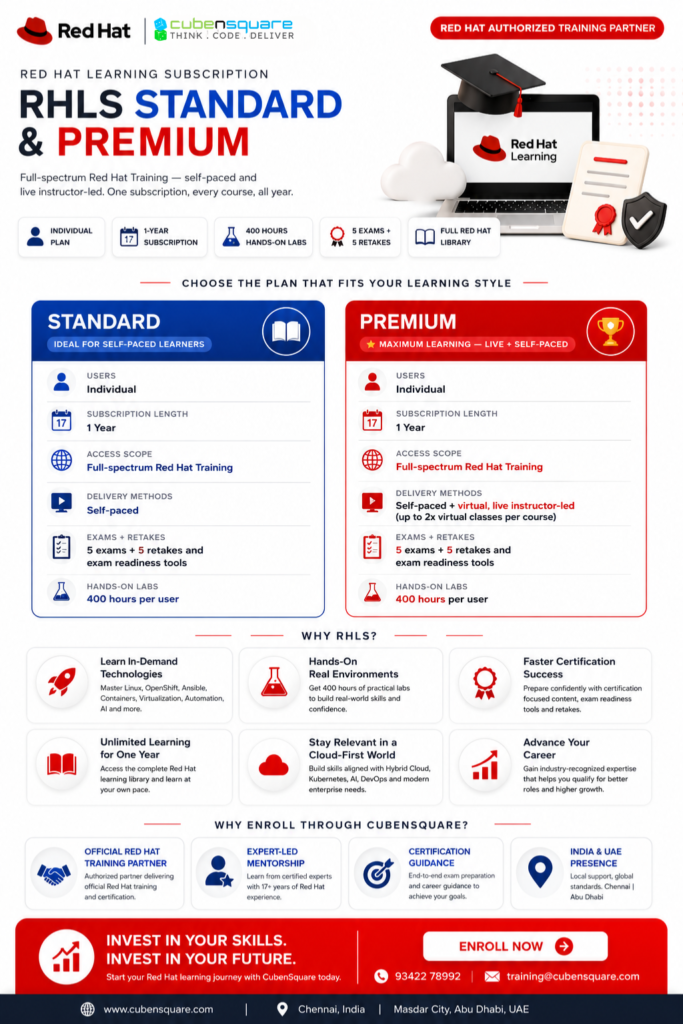
Redhat Learning Subscription
Comprehensive training and learning pathways on Red Hat products, industry-recognized certifications, and a flexible and dynamic IT learning experience.