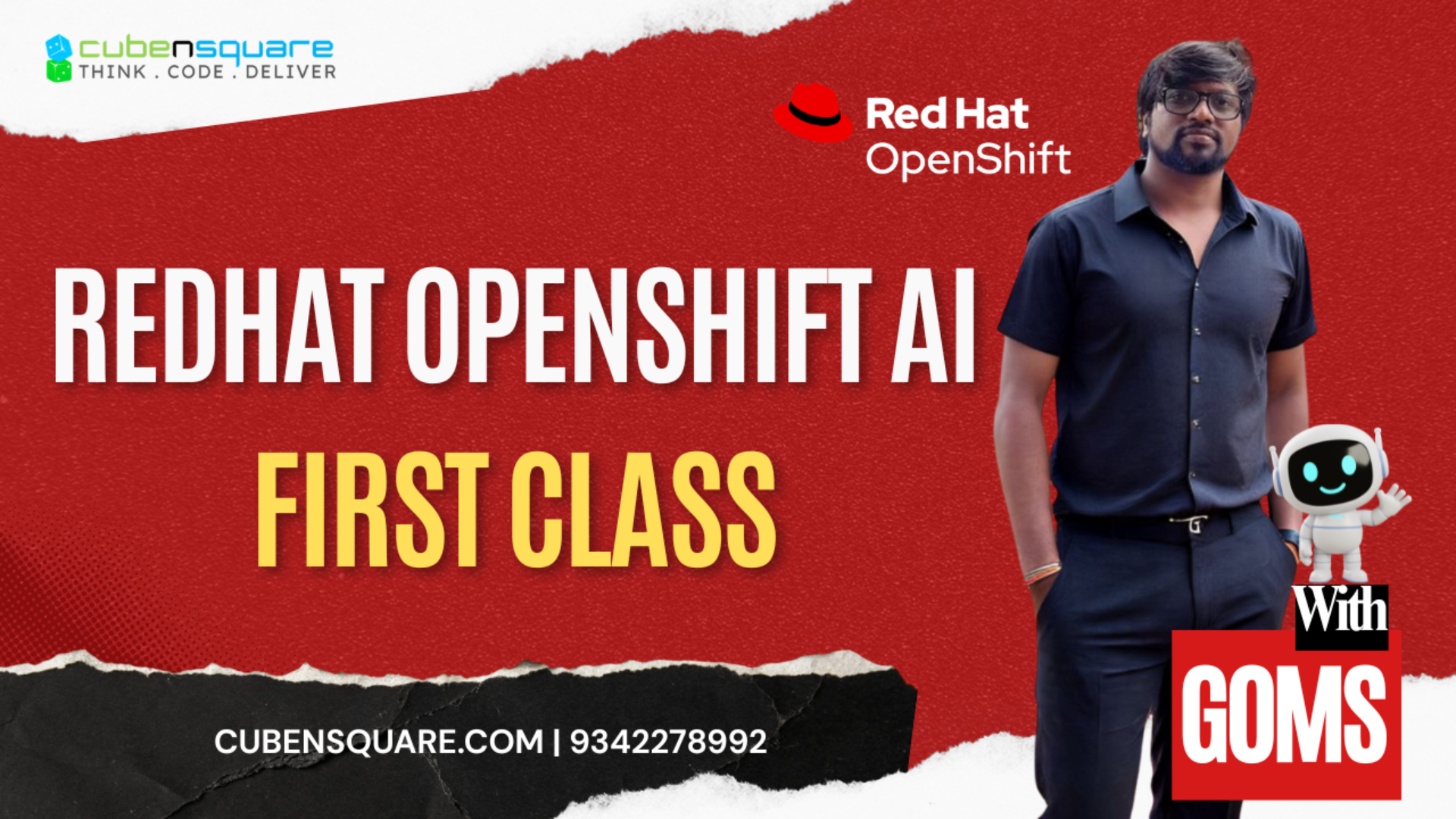
Redhat OpenShift AI
AI267 | EX267
- 15 Chapters
- Redhat Ebook
- Redhat Exam
Developing and Deploying AI/ML Applications on Red Hat OpenShift AI
Operationalize the complete life cycle of modern AI applications at scale by using Red Hat OpenShift AI.
Developing and Deploying AI/ML Applications on Red Hat OpenShift AI (AI267) provides students with the fundamental knowledge to manage the complete life cycle of modern AI applications. This course helps students build core skills for using Red Hat OpenShift AI to efficiently train, test, deploy, and monitor both predictive and generative AI models at scale.
This course is based on Red Hat OpenShift ® 4.20, and Red Hat OpenShift AI 3.3.
Course Content Summary
- Introduction to Red Hat OpenShift AI
- Using Workbenches for AI/ML Development
- Fundamentals of Model Serving
- Serving Predictive AI Models
- Monitoring AI Models
- Introduction to AI Pipelines
- Advanced Kubeflow Pipelines Development and Experiments
- Gen AI Model Optimization and Evaluation
- Building GenAI Applications
Target Audience
- ML Engineers responsible for handling the operational tasks of the MLOps/LLMOps lifecycle, such as deployment, automation, and monitoring.
- Data Scientists who train, deploy, and track their own models.
Introduction to Red Hat OpenShift AI
Identify how Red Hat OpenShift AI provides a complete MLOps and GenAIOps platform and how to use it to configure data science projects for team collaboration.
Using Workbenches for AI/ML Development
Use workbench environments for AI/ML development and connect them to data sources and stores.
Fundamentals of Model Serving
Prepare, deploy, and serve models by using OpenShift AI model serving capabilities.
Serving Predictive AI Models
Deploy and serve predictive AI models with specific runtimes, including OpenVINO.
Monitoring AI Models
Monitor deployed models for bias, data drift, and performance by using TrustyAI and observability tools to ensure reliable and ethical AI performance in production.
Introduction to AI Pipelines
Create and manage basic data science pipelines by using Elyra and Kubeflow SDK to automate fundamental AI/ML workflows.
Advanced AI Pipelines Development and Experiments
Implement advanced pipeline features including container components, artifacts management, Kubernetes configuration, and systematic experimentation for production MLOps workflows.
Gen AI Model Optimization and Evaluation
Systematically optimize and evaluate large language models by using RHOAI's compression techniques and evaluation frameworks.
Building GenAI Applications
Build production-ready GenAI applications by using industry patterns including RAG, agentic workflows, and trustworthy AI practices, and move beyond basic model serving to ship complete intelligent solutions.
Impact on the Organization
- Organizations often see their data science efforts slowed by manual tasks and the increasing complexity of integrating AI tools, especially with Generative AI. With Red Hat OpenShift AI, organizations gain a unified platform to manage the complete life cycle of modern AI applications. This capability allows them to efficiently train, test, deploy, and monitor both predictive and generative AI models at scale, transforming experimental initiatives into reliable business outcomes.
Impact on the Individual
- As a result of attending this course, you will be able to manage the complete life cycle of modern AI applications, by efficiently training, testing, deploying, and monitoring both predictive and generative AI models at scale. You will learn to configure collaborative data science projects, efficiently utilize workbench environments, and assign specialized resources. You will prepare, deploy, and serve models by using specialized runtimes. Furthermore, you will automate MLOps workflows by creating advanced data science pipelines, and build production-ready GenAI solutions. Finally, you will ensure reliable and ethical AI performance by monitoring deployed models for bias and data drift using, and implement safety guardrails for generative applications.
Recommended next course or exam
- Red Hat Certified Specialist in OpenShift AI Exam (EX267)
Exam Description
The Red Hat Certified Developer in AI exam tests candidates' ability to deploy OpenShift AI and configure it to build, deploy and manage machine learning models to support AI enabled applications.
By passing this exam, you become a Red Hat Certified Developer in AI.
This exam is based on Red Hat OpenShift AI version 3.3 and Red Hat OpenShift Container Platform version 4.20.
Study points for the exam
Candidates for the Red Hat Certified Specialist in OpenShift AI should be able to accomplish the following tasks. Relevant product specific documentation will be provided but candidates should be prepared to perform these tasks without assistance.
- Understand Red Hat OpenShift AI architecture and fundamentals
- Understand RHOAI’s relationship with OpenShift Container Platform
- Understand MLOps, GenAIOps, and AI/ML concepts
- Know how RHOAI components work in data science projects
- Manage data science projects and workbenches
- Create, configure, and manage projects and permissions
- Create and edit workbenches with custom images, versions, and sizes
- Build and import custom workbench images
- Monitor resource usage and training processes with TensorBoard
- Configure data connections
- Create connections (S3, database, etc.)
- Store and retrieve data and artifacts from external services
- Identify and allocate resources
- Use nodeSelectors and tolerations
- Allocate workbenches and model servers to specific nodes
- Deploy and serve models
- Understand model serving workflow and KServe architecture
- Deploy models using Standard and Advanced modes
- Store models in S3 buckets, OCI containers, or PVCs
- Serve predictive models with OpenVINO runtime
- Deploy and serve LLMs with vLLM runtime
- Create and configure custom serving runtimes
- Manage models with the Model Registry
- Package models as OCI image artifacts
- Register and version models in the Model Registry
- Deploy models from the Model Registry
- Query the Model Registry API
- Monitor AI models and performance
- Monitor model bias and data drift with TrustyAI
- Monitor hardware consumption with OpenShift monitoring stack and Grafana
- Analyze resource utilization and optimize based on monitoring insights
- Create and manage data science pipelines
- Create pipeline servers and pipelines with Elyra and KubeFlow SDK
- Use container components and manage artifacts
- Configure Kubernetes features in pipelines
- Use experiments to compare pipeline runs
- Optimize and evaluate models
- Select models from RHOAI catalog and Hugging Face
- Optimize models with LLM Compressor (compression and quantization)
- Evaluate LLM performance with LMEval using standard and custom benchmarks
- Build GenAI applications
- Understand and apply GenAI application patterns
- Build simple GenAI applications with streaming responses
- Build RAG applications with vector databases and document processing
- Build agentic applications with tools and multi-step reasoning
- Implement guardrails for content safety and input/output validation
- Collaborate with Git and develop ML models
- Manage Jupyter notebooks with Git version control
- Train models in Python using foundational ML libraries
- Load data scalably and save/export models
- Deploy and Store Models
- Deploy models using OpenShift AI interface (Standard and Advanced modes)
- Store models using S3 buckets, OCI containers, or persistent volume claims
- Understand supported model storage locations
- Configure model deployment settings
Other Redhat Courses
Master Red Hat Linux, Ansible Automation, OpenShift, OpenShift AI, Virtualization, and Enterprise Kubernetes.
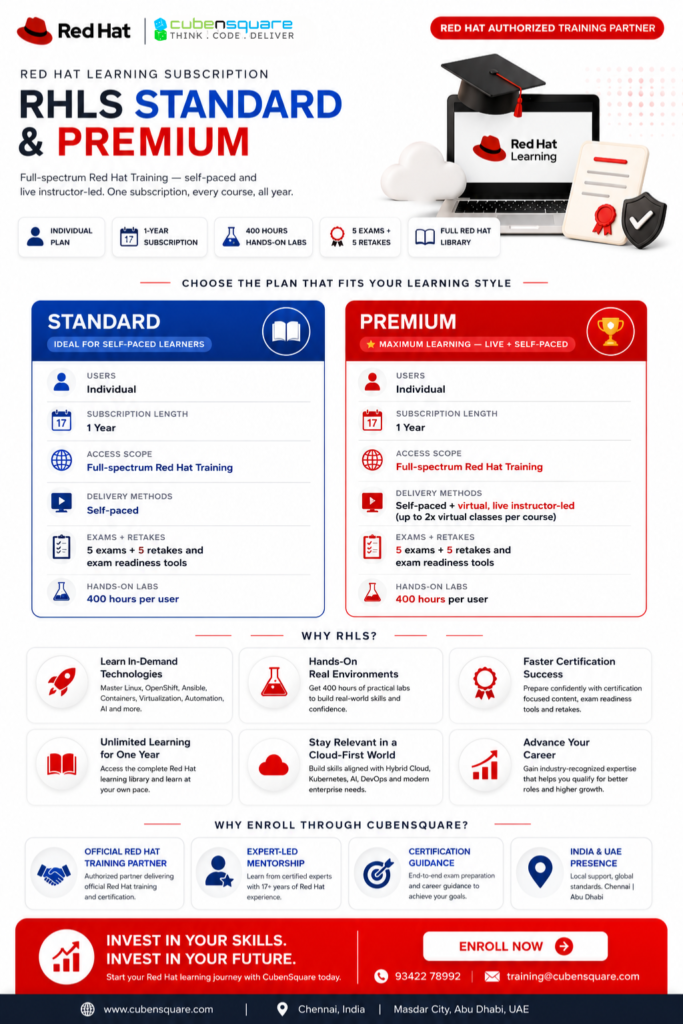
Redhat Learning Subscription
Comprehensive training and learning pathways on Red Hat products, industry-recognized certifications, and a flexible and dynamic IT learning experience.