Multicluster Management with Red Hat Advanced Cluster Management for Kubernetes
DO432 | EX432
- 10 Chapters
- Redhat Ebook
- Redhat Exam
Red Hat OpenShift Cluster Management
Address challenges with management, compliance, and productivity of a multicluster Kubernetes environment and its applications by using the capabilities of Red Hat Advanced Cluster Management for Kubernetes.
Course Description
Multicluster Management with Red Hat Advanced Cluster Management for Kubernetes (RHACM) teaches the required skills to manage a fleet of containerized applications and Kubernetes clusters, by automating compliance with security, governance, and other organization policies, and by implementing GitOps practices.
Course Content Summary
- Describe and implement the RHACM architecture and its components, and follow recommended practices for its installation.
- Import and manage a cluster by using the RHACM web console, configure user access to clusters, and troubleshoot common import issues.
- Deploy and manage policies in a multicluster environment by using RHACM governance.
- Monitor a fleet of managed clusters and troubleshoot performance and availability issues by using RHACM observability components.
- Deploy and manage applications in a multicluster environment by using RHACM and GitOps.
- Deploy and manage virtual machines in a multicluster environment by using RHACM and GitOps.
Target Audience
- IT Operations personnel who are responsible for managing the lifecycle and monitoring the usage of multiple clusters.
- DevOps and Site Reliability Engineers who are responsible for monitoring the health of clusters and Kubernetes deployments and for maximizing their uptime. These individuals also automate the provisioning or deprovisioning of clusters and the workload placement based on capacity and policy.
- Security Operations personnel who are responsible for ensuring that Kubernetes deployments comply with regulatory and organizational standards. These individuals create security policies across diverse environments and ensure enforcement.
Prerequisites for this course
- Take our free assessment to gauge whether this offering is the best fit for your skills.
- Completing Red Hat OpenShift Administration II: Configuring a Production Kubernetes Cluster (DO280) and Red Hat Certified OpenShift Administrator exam (EX280) are strongly encouraged, or possessing equivalent Kubernetes and OpenShift administration skills.
- The following optional courses are recommended:
- Red Hat OpenShift Administration III: Scaling Deployments in the Enterprise (DO380) is a course on how to configure and manage OpenShift clusters at scale to address increasing and complex demands from applications and to ensure reliability, performance, and availability.
- Managing Virtual Machines with Red Hat OpenShift Virtualization (DO316) covers the essential skills to create and manage virtual machines on OpenShift by using the Red Hat OpenShift Virtualization operator.
Course Outline
- Installing Red Hat Advanced Cluster Management for Kubernetes
- Describe and implement the RHACM architecture and its components, and follow recommended practices for its installation.
- Managing Clusters by Using Red Hat Advanced Cluster Management for Kubernetes
- Import and manage a cluster by using the RHACM web console, configure user access to clusters, and troubleshoot common import issues.
- Deploying and Managing Policies for Multiple Clusters with Red Hat Advanced Cluster Management for Kubernetes
- Deploy and manage policies in a multicluster environment by using RHACM governance.
- Enabling and Customizing the Red Hat Advanced Cluster Management for Kubernetes Observability Stack
- Monitor a fleet of managed clusters and troubleshoot performance and availability issues by using RHACM observability components.
- Managing the Multicluster Application Lifecycle by Using GitOps Practices and Red Hat Advanced Cluster Management for Kubernetes
- Deploy and manage applications in a multicluster environment by using RHACM and GitOps.
- Managing Virtual Machines for Multiple Clusters with Red Hat Advanced Cluster Management for Kubernetes
- Deploy and manage virtual machines in a multicluster environment by using RHACM and GitOps.
- Installing Red Hat Advanced Cluster Management for Kubernetes
Impact on the Organization
- Multicluster Management with Red Hat Advanced Cluster Management for Kubernetes supports IT Operations and Development teams whose organizations are expanding and accelerating their container adoption journeys. The course enables organizations to securely and consistently apply governance, security, and application placement policies across multiple Kubernetes clusters. Organizations will benefit through increased automation of cluster, application, and virtual machine lifecycles at scale, all from a unified point of control.
Impact on the Individual
- Multicluster Management with Red Hat Advanced Cluster Management for Kubernetes teaches the advanced skills to control multiple OpenShift clusters. Students will learn how to use GitOps practices for a multicluster environment, how to assess cluster compliance based on industry-standard benchmarks and get remediation guidance, and how to apply their own security policies for workloads that are hosted on multicloud or hybrid cloud environments to meet internal standards for software engineering, secure engineering, resilience, security, and regulatory compliance.
Recommended next course or exam
Study points for the exam
To help you prepare, the exam objectives highlight the task areas you can expect to see covered in the exam. Red Hat reserves the right to add, modify, and remove exam objectives. Such changes will be made public in advance.
As part of this exam, you should be able to perform these tasks:
- Manage and deploy Red Hat Advanced Cluster Management for Kubernetes (RHACM)
- Understand how RHACM architecture and components work
- Deploy RHACM using Red Hat OpenShift Container Platform Operator Lifecycle Management
- Install RHACM agents in a managed cluster
- Use RHACM from the web terminal or the command line interface
- Manage clusters by using Red Hat Advanced Cluster Management for Kubernetes (RHACM)
- Create, upgrade, import and remove a cluster
- Scale a cluster
- Configure access control for multi-cluster management
- Configure objects related to access control in a fleet cluster, such as roles, cluster sets, cluster selectors, and placement rules
- Understand how to use the multi-cluster management dashboard search engine
- Create and manage role-based access controls (RBAC)
- Manipulate policies for groups and users
- Manipulate cluster sets
- Deploy and manage policies for multiple clusters
- Understand governance architecture and related components
- Manipulate RHACM policies and associated components
- Configure and use the Compliance Operator for multiple clusters
- Understand how Compliance Operator policy cluster resource definitions work and be able to manipulate them
- Troubleshooting issues related to governance
- Manage the RHACM observability service
- Understand the RHACM observability architecture
- Enable the observability stack
- Manage the observability stack
- Customize the observability stack
- Use Kustomize to manage resources
- Understand how to manage templates
- Manage apps using Kustomize
- Manage multi-cluster application lifecycle using GitOps practices
- Be able to work with Git from the CLI
- Be able to integrate with Kustomize
- Organize Git repositories to support GitOps
- Configuring GitOps for application lifecycle management
- Deploy and configure GitOps Operator
- Manipulate applications using Git repositories
- Importing Managed Clusters into Argo CD
- Use the application console to manage and manipulate applications
- Troubleshoot common issues for application lifecycle management
- Manage Virtualization Operator
- Understand the Red Hat Virtualization Operator architecture and components
- Deploy the OpenShift Virtualization Operator using GitOps with RHACM
- Deploy and manage Multicluster Virtual Machines with RHACM
- Monitor OpenShift Virtualization with RHACM
As with all Red Hat performance-based exams, configurations must persist after reboot without intervention.
Other Redhat Courses
Master Red Hat Linux, Ansible Automation, OpenShift, OpenShift AI, Virtualization, and Enterprise Kubernetes.
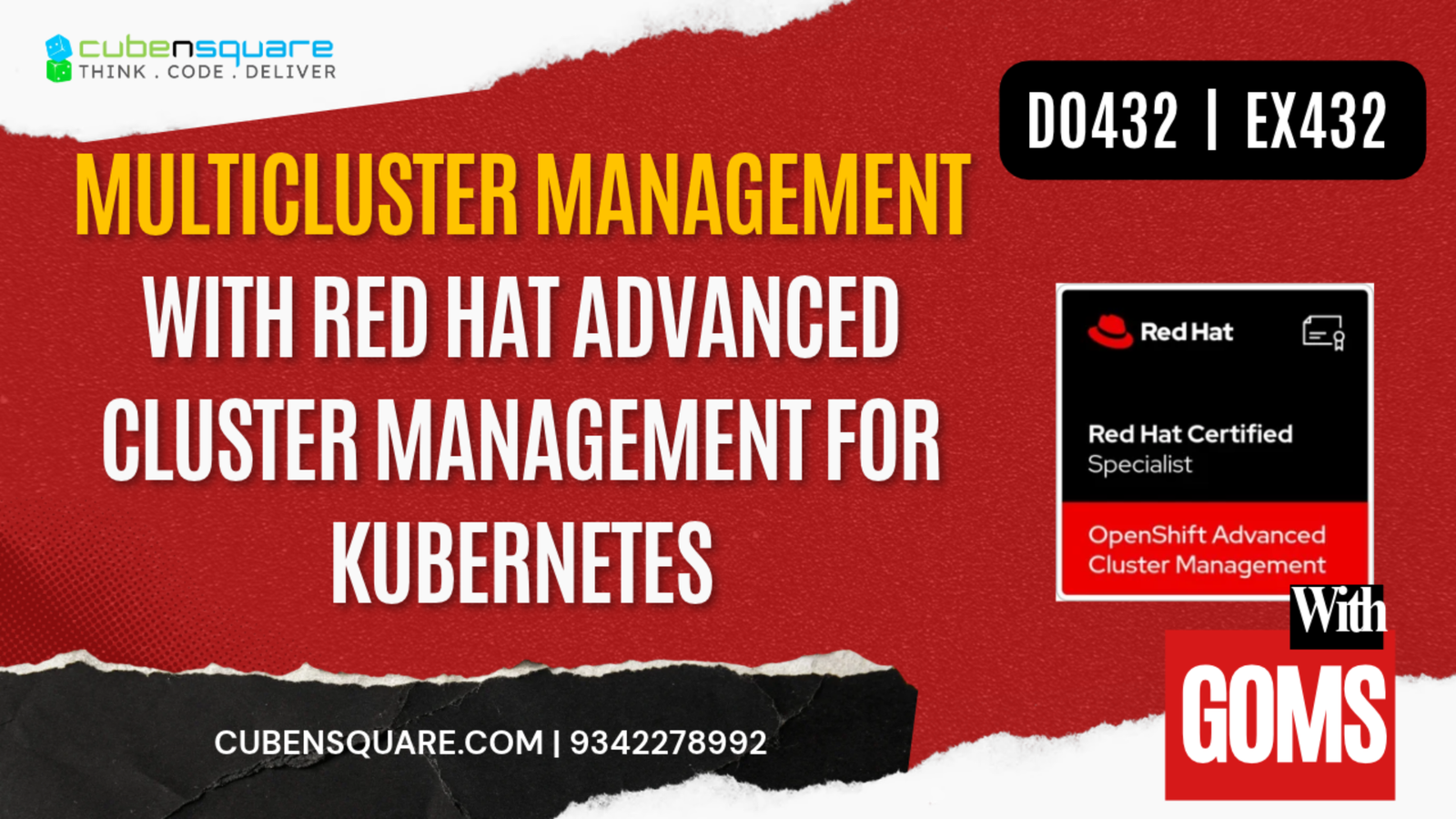
Redhat Learning Subscription
Comprehensive training and learning pathways on Red Hat products, industry-recognized certifications, and a flexible and dynamic IT learning experience.