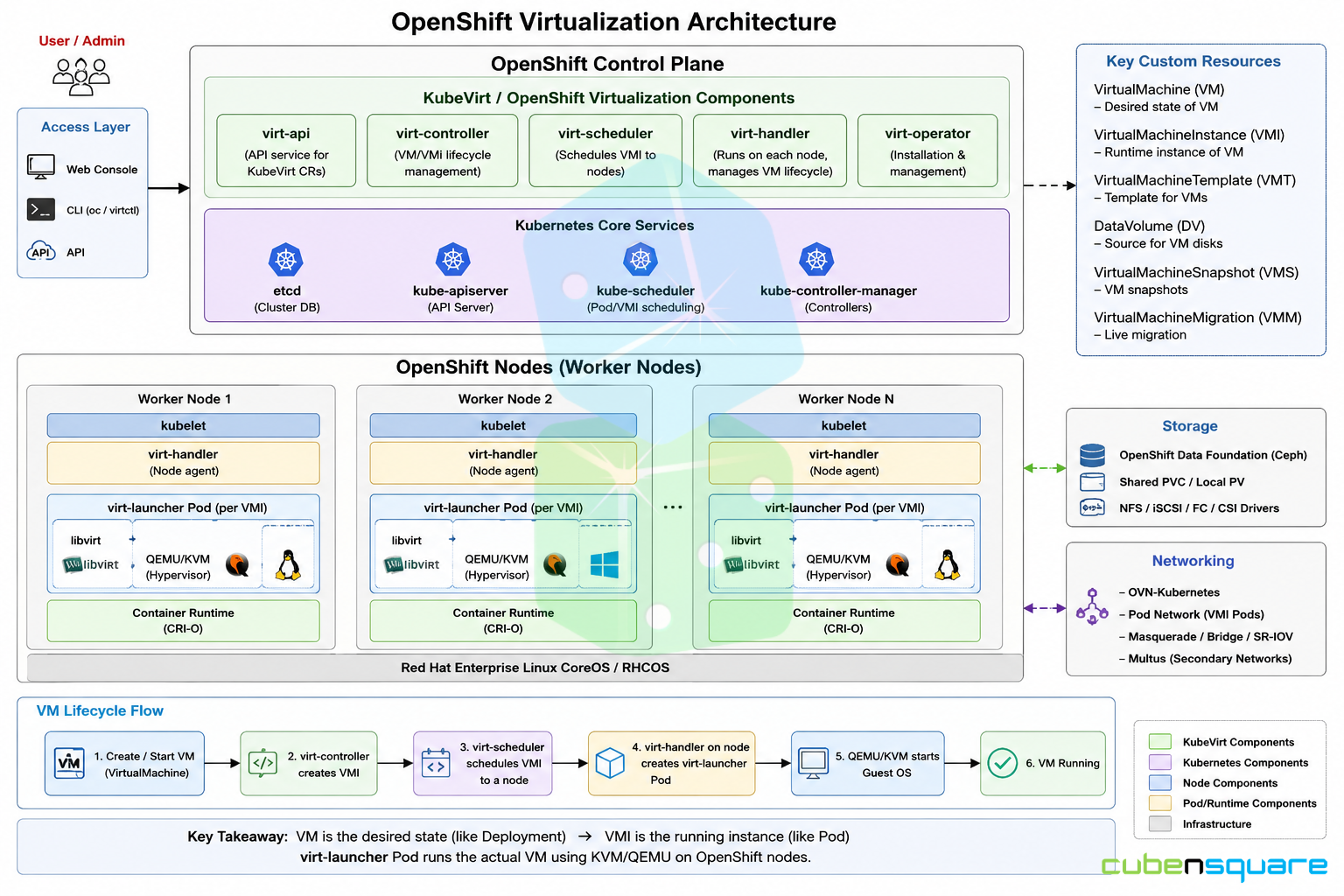
OpenShift Virtualization enables organizations to run traditional Virtual Machines (VMs) alongside Kubernetes containers on a single OpenShift platform. Powered by KubeVirt, it extends Kubernetes with virtualization capabilities, making VM lifecycle management simple and automated.
Components like virt-api, virt-controller, virt-scheduler, and virt-handler work together to create, schedule, and manage VMs across worker nodes. Each VM runs inside a virt-launcher pod using the QEMU/KVM hypervisor, ensuring high performance and isolation. Kubernetes services such as etcd, kube-apiserver, and kube-scheduler provide the foundation for orchestration and cluster management. Storage is supported through OpenShift Data Foundation, Ceph, PVCs, and CSI drivers, while networking is powered by OVN-Kubernetes, Multus, SR-IOV, and bridge networking. The platform also offers powerful resources like VM snapshots, live migration, templates, and DataVolumes for enterprise-grade operations.
This unified architecture simplifies infrastructure management, accelerates application modernization, and enables seamless migration of legacy workloads into a cloud-native ecosystem. OpenShift Virtualization is the ideal solution for organizations looking to modernize without leaving their existing virtualized applications behind.